
Alpine Race Team
Ages 10–11
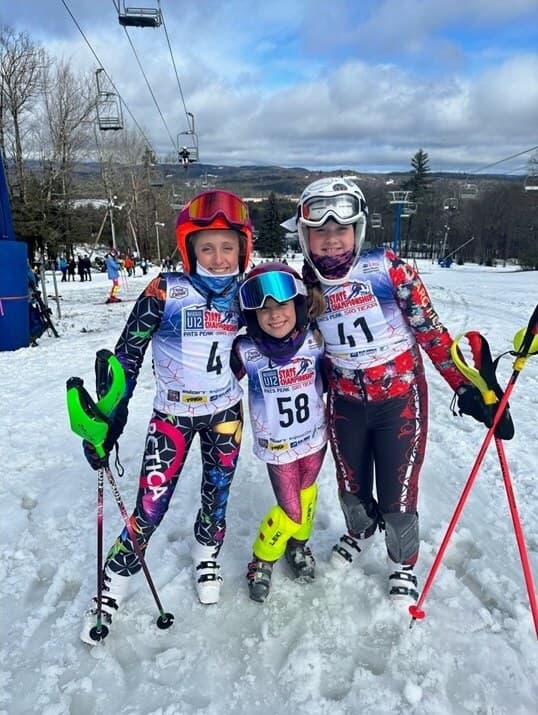
The U12s.
Slalom, giant slalom and speed skills trained in gates, with racing around the region and a shot at states.
At a glance
- Ages
- Ages 10–11
- Practices
- Tuesday and/or Thursday evenings 5:30–7:00pm plus Saturday mornings 8:30–11:00am. Two-day or three-day options.
- Tuition, 2026–27
- $725 for two days a week, $925 for three. Every group’s price, and rentals
- Memberships
- US Ski & Snowboard, and NHARA for an athlete who races. Which ones to buy
What this year is for
Skills acquisition and application to racing
Athletes in the U12 Abenaki program continue a two- to four-year plan to develop properly for the next level of ski racing. The range of developmental maturation at this level can be broad, so coaches design seasonal plans based on individual goals and needs.
Athletes learn the fundamentals of slalom (SL), giant slalom (GS), and speed skills, with an emphasis on technical proficiency over speed. This focus provides athletes with the necessary tools and skills to succeed at the next level and beyond.
To be successful, athletes train and compete as a cohesive unit, supporting each other and developing a solid team environment. Racing at this level is focused on the process and training involved in preparation for the event, not on the result.
What to bring
Must have
- A hard-ear helmet with a chin-bar attachment.
- One pair of GS skis.
- One pair of slalom skis.
- One pair of rock or powder skis.
- GS and slalom poles with guards.
- Shin guards.
- A GS suit.
- Goggles with both a light and a dark lens.
- Durable leather mittens or gloves, the Kinco sort. Other materials do not survive the rope tow.
Nice to have
- Zip-off snow pants.
- A FIS-approved helmet.
The season
Physical
- Participate in a structured dry land training program to improve fitness and familiarity with teammates and environment.
Mental
- Learn mental training skills appropriate to their level, including visualization, focus, positive self talk, relaxation, and pre-run/pre-race routines.
On snow training and racing
- Follow a training schedule designed to prepare for upcoming races, culminating in the Qualifying Races for their age group.
- Each training session will have a specific theme, purpose, and goal.
- Athletes must master basic skills before moving on to advanced topics.
- Enter each race with the goal of improving their performance in a specific area.
- Achieving personal development is more important than overall results.
- Athletes may have differing training and racing focus depending on their current stage of development.
Equipment maintenance
- Develop basic tuning skills and ski maintenance.
Phase 3
What a U12 coach is working on
These are the development goals US Ski & Snowboard sets for phase 3, and what our coaches plan a season around. GS is giant slalom, SL slalom, SG super-G and DH downhill.
On the skis
- General focus
- Technical stage — developing precision of basic skills while learning advanced techniques over a variety of terrain and features.
- Athletic stance and balance
- Able to demonstrate a clear balanced weight transfer in transition. Able to initiate turn on either inside or outside ski. Beginning to utilize fore aft pressure throughout the turn. Can maintain ski to snow contact on most terrain.
- Skills: rotary, edging and pressure
- Skier can edge ski in different phases of the turn. Edging is achieved by angulation and/or inclination as turn radius and speeds change. Rotation comes from the hip socket.
- Turn strategies
- Ability to maintain turn shape in a variety of turn sizes. Explore turn size allowing for smooth arc to arc execution.
- Coordination of movement
- Turn initiation movements appear to start in the ankles and move up the kinematic chain. Upper/lower body separation is demonstrated by a stable upper body biased down the hill or race line. Optimal ski to snow pressure is maintained through gross and micro leg movements.
On the course
- Terrain
- Gaining comfort in applying various tactics in order to ski terrain using different strategies to achieve different results.
- Giant slalom and slalom
- Demonstrates understanding of GS line, appropriate to ability. Slalom gate clearing does not disrupt balanced turn mechanics.
- Downhill and super-G
- Executes SG speed turns in a tuck. SG speed and turn duration is practiced. Athletes seek out jumps during free skiing. Athlete learns jump progression for speed events.
- Course sets
- Skis a variety of training courses that introduce line and tactics through self-discovery. Introduce more tactical focused drill courses. Skis slalom and GS training courses that have variety.
- Competition strategies
- Racing more GS & SL added to a continuation of dual racing, obstacle courses and skill competitions.
Who’s on the hill
U12 coaches

Bey Guerster
Mason Guerster
 U12 Coach
Tim Lefebvre
The other age groups
- Ages 6–7U8For a kid who can ride the big rope tow, with very little racing.
- Ages 8–9U10Race-specific fundamentals and a few local races, on every kind of terrain and snow the hill has.
- Ages 12–13U14Slalom, giant slalom and speed skills built toward mastery, and for some athletes, super-G training.
Ready to sign up?
Registration runs through Ski Club Pro. Every athlete needs a season pass and a US Ski & Snowboard membership before the first day on snow.